


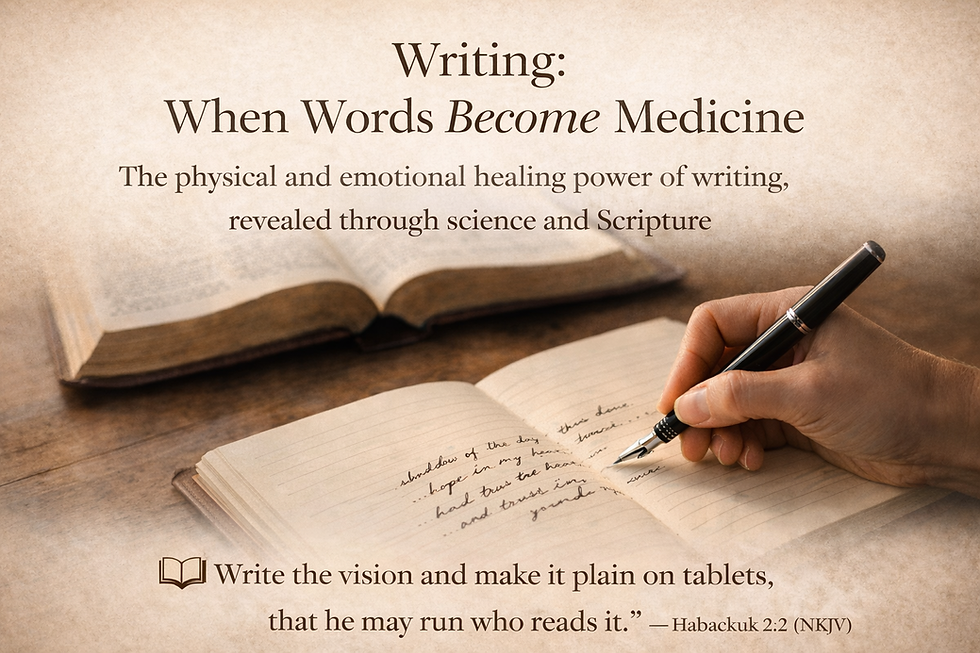
Writing: When Words Become Medicine

The physical and emotional healing power of writing, revealed through science and Scripture
There are moments when the heart is full, yet the mouth cannot speak. Thoughts circle endlessly. Emotions press against the chest with nowhere to go. In these moments, the simple act of writing becomes more than expression. It becomes relief. It becomes regulation. It becomes healing.
For decades I've used poetry, journaling, and blogging as a means to process pain. Ink carried what my voice could not yet hold. Words stitched fragmented places together.
Long before neuroscience caught up, God already knew the power held in words written slowly and truthfully. Pages have carried prayers, laments, confessions, and hope across generations. Today, research confirms what faith has always known. Writing changes us, from the inside out.
📖 “Write the vision and make it plain on tablets, that he may run who reads it.” — Habakkuk 2:2 (NKJV)
Writing and the Body
How words calm the nervous system
Scientific research into expressive writing, particularly studies led by Dr James Pennebaker, shows that regular writing about thoughts and emotions produces measurable physical benefits.
Participants who engaged in consistent writing experienced:
Lower stress hormone levels
Reduced blood pressure• Improved immune function• Better sleep quality
Fewer stress-related illnesses
Reduced chronic pain symptoms
Faster recovery from injury and illness
When emotions remain unexpressed, the body often carries the load. Muscles tense. Breathing becomes shallow. The nervous system stays on high alert. Writing helps interrupt this pattern. It allows the brain to process what the body has been bracing against.
Putting experiences into words signals safety. The limbic system quiets. The prefrontal cortex engages. The body begins to stand down.
Writing does not erase pain. It helps the body stop fighting it.
Writing and the Mind
Turning chaos into coherence
Emotionally charged experiences often live in the brain as fragments. Sensations without story. Feelings without framework. Writing brings order where there was overwhelm.
Psychologists describe writing as a process of cognitive organisation. It helps us:
• Clarify confusing thoughts
Reduce mental rumination
Identify emotional patterns and triggers• Process grief and loss
Make sense of traumatic memories• Strengthen emotional regulation
Improve problem-solving and decision-making
When we write, the brain slows enough to sort. Meaning begins to emerge. This meaning-making process is one of the strongest predictors of long-term resilience. Suffering becomes something we can understand, rather than something that simply happens to us.
Writing and Emotional Healing
A safe place to feel without being undone
Writing offers a private, non-judgemental space where emotions can surface honestly. Anger can speak without harming. Grief can breathe without being rushed. Fear can be named instead of suppressed.
Therapists often use writing to help restore agency after trauma. Each sentence becomes an act of choice. Each page says, “My story matters.”
Writing supports emotional healing by:
• Validating lived experience
Reducing feelings of isolation• Increasing self-compassion
Helping emotions move rather than stagnate• Allowing truth to surface gently
Giving language to what was once overwhelming
Silence keeps wounds suspended in the body. Words allow them to move.
Writing as a Spiritual Practice
Bearing witness in the presence of God
Scripture is filled with written prayers, journals of faith, and recorded encounters with God. David wrote his anguish and his praise. Jeremiah wrote through heartbreak. Paul wrote from prison. John wrote from exile.
Writing has always been a way God invites His people to remember, reflect, and testify.
📖 “My heart is overflowing with a good theme; I recite my composition concerning the King; my tongue is the pen of a ready writer.” — Psalm 45:1 (NKJV)
Writing before God becomes a form of prayer. It slows us enough to listen. It allows truth to rise without performance. It creates space for the Holy Spirit to gently reveal, restore, and reorder what has been dislodged inside.
Why Writing Heals So Deeply
Researchers note that writing is uniquely powerful because it integrates three critical systems at once:
Cognitive — organising thoughts and memories
Emotional — expressing feelings safely
Physical — reducing stress responses in the body
Few practices engage all three simultaneously. Writing does not demand perfection. It only asks for honesty.
For the One Carrying an Unfinished Story
Some stories were interrupted. Some conversations never happened. Some wounds never had a witness. Writing offers a way to finish what was left open. It allows grief to complete its arc and truth to find its voice.
Healing rarely arrives all at once. More often, it unfolds line by line, page by page, in quiet moments where ink meets courage and God meets us gently.
📖 “Cast your burden on the Lord, and He shall sustain you.” — Psalm 55:22 (NKJV)
Sometimes, the casting begins with a pen.




Comments